
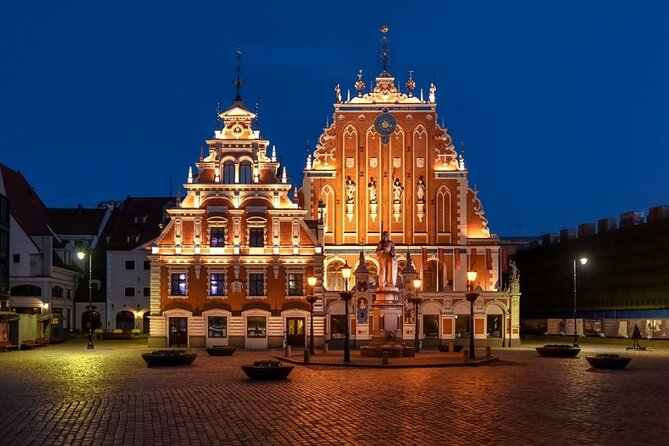
Review · HISTORICAL TOURS
Private Soviet Riga tour
Soviet Riga still speaks quietly. This private walking tour helps you hear it, using central Riga’s streets, monuments, and buildings to explain Latvia’s difficult path from Stalin to Gorbachev and beyond. I especially like the private format, which gives you room to ask questions, and the guide’s use of family experience to make political history feel personal. The main consideration is pace: ten stops in about two hours means some subjects are introduced rather than explored at length.
The walk begins at Latviešu strēlnieku laukums and ends at the Daile Theatre, about 15 minutes on foot from Riga’s Old Town. Guide Edvards has earned praise for making a complicated subject easy to follow, and the tour can be tailored to your interests. It is a strong pick if you want more than pretty façades and cafés, but it may feel intense if you prefer a light sightseeing stroll.
In This Review
- Key points about the Soviet Riga walk
- Why Soviet history changes the way you see Riga
- Latviešu strēlnieku laukums and the red riflemen
- Deportation and memory at the Museum of the Occupation
- The 1991 barricades at Barikazu Laukums
- The Baltic Way, explained beyond the famous photograph
- The Freedom Monument and Soviet survival
- Religion and power at the Nativity Cathedral
- Hotel Latvia and the unease of a western guest
- Brivibas Iela, from Lenin Street to Freedom Street
- The KGB building and the machinery of fear
- Daile Theatre and the collapse of Soviet power
- What the private format is worth at $180.62
- Who will get the most from this walk
- Should you book the Private Soviet Riga tour?
- FAQ
- Where does the Private Soviet Riga tour begin?
- Where does the tour finish?
- How long does the tour last?
- How much does the private tour cost?
- Is the tour offered in English?
- Is hotel pickup or drop-off included?
- Are museum admission tickets included?
- Can children join the tour?
- Can I cancel for a full refund?
Key points about the Soviet Riga walk
- Edvards brings personal context: His family experience adds a human angle to Latvia’s Soviet-era story.
- The route connects major events: You move from the red riflemen and Stalinist repression to the 1991 barricades and independence.
- The KGB headquarters is a powerful stop: Recruitment, interrogation, surveillance, and the building’s role in Latvia are discussed.
- The Baltic Way gets practical attention: You learn not only what happened, but how a huge peaceful protest was organized.
- It is private for up to 15 people: Your party receives the guide’s attention, with freedom to ask questions as you go.
- The walk finishes outside the Old Town: Plan a little extra time for the return, since the Daile Theatre is roughly 15 minutes away.
Why Soviet history changes the way you see Riga
Riga can be easy to admire at street level. You have grand boulevards, ornate buildings, church towers, and lively public squares. Yet much of the city’s modern identity was shaped by occupation, forced population movements, censorship, fear, and a long struggle to restore independence.
This tour gives you a framework for understanding those visible places. Instead of treating each monument as an isolated sight, Edvards links them to the Soviet period and to the events that brought Latvia back to independence.
That connection matters. The Freedom Monument, for example, is not simply a photogenic landmark. The Orthodox cathedral is not only a place of worship. The former Hotel Latvia is not just a tall central hotel. Each site carries a political story, and the walking route lets you see those links without spending time on transfers.
The tour is offered in English and lasts about two hours. Since it is private, you can ask for clarification as you go. That is useful with a subject full of unfamiliar names, dates, and competing memories.
More history tours in Riga:
- Visit of Salaspils Memorial Ensemble
★ 5.0 · 10 reviews - Riga Jewish History Tour
★ 5.0 · 9 reviews - Private Day Tour to Sigulda, Turaida Castle and Soviet Bunker
★ 4.5 · 8 reviews
Latviešu strēlnieku laukums and the red riflemen
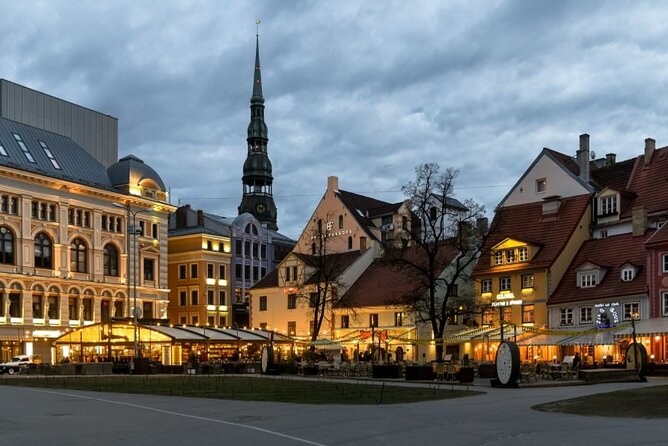
The opening stop at Latviešu strēlnieku laukums sets the historical clock. Edvards explains the main stages of the Soviet period, from Stalin through Khrushchev, Brezhnev, and Gorbachev, giving you the basic political map needed for the rest of the walk.
The square’s monument to the Latvian red riflemen opens a more complicated discussion. These Latvian soldiers became associated with the Bolshevik cause, and their place in Soviet cultural memory was politically important. The monument therefore helps introduce a recurring theme: Latvia’s past cannot always be divided into simple heroes and villains.
You spend about 15 minutes here. That is enough for orientation and questions, though anyone hoping for a detailed military history will need to keep expectations in check. The real value is the foundation it gives the next stops.
Deportation and memory at the Museum of the Occupation
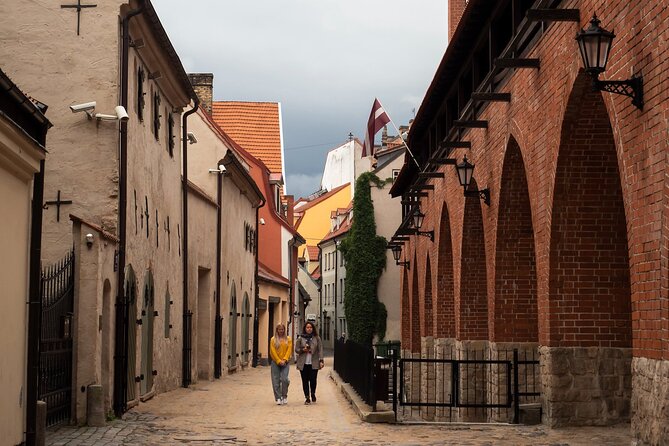
The stop outside the Museum of the Occupation of Latvia focuses on deportations to Siberia. You hear about why people were deported, the scale of the removals, and the damage done to families and Latvian society.
The museum itself is listed as a stop, but no admission is included and the tour description does not promise an interior visit. Treat this part as an outdoor explanation connected to the museum’s subject, not as a full museum tour.
That distinction is important for planning. If you want to spend time inside the museum, arrange a separate visit. The walking tour gives you a short, focused account in roughly ten minutes, which can help you understand what you later see in the museum’s exhibits.
This is one of the heavier moments of the route. The subject is not decorative history, and Edvards’ personal approach is especially useful here. His family connection, as described by past participants, helps bring the impact down from state policy to ordinary people.
The 1991 barricades at Barikazu Laukums
At 1991 Barikazu Laukums, the story moves from repression to open resistance. This is where Edvards explains the barricades, the period when Latvians gathered to protect key institutions during the final struggle for independence.
The stop lasts about ten minutes, so you will get the main story rather than a long chronological account. Still, its position in the walk works well. You have just heard about deportation and state control, and now you see how the independence movement reached its most dramatic stage.
I like this part because it puts political change into a physical setting. The barricades were not an abstract declaration. They involved people occupying public spaces and trying to defend the future of their country.
If you have a strong interest in the independence movement, use the private format to ask for more detail. Edvards is specifically praised for answering questions while walking between stops, so the route does not have to end when the scheduled explanation does.
A completely different kind of day out:
- Riga Old Town walking tour
★ 4.5 · 304 reviews - Latvian food tasting tour at Riga Central market
★ 4.5 · 241 reviews - 2 countries! Hill of Crosses, Rundale Palace and Bauska castle
★ 5.0 · 225 reviews - Discover Riga Bike Tour
★ 5.0 · 166 reviews
The Baltic Way, explained beyond the famous photograph
The Baltic Way Footprint Monument recalls one of the most striking peaceful protests of the late Soviet period. On August 23, 1989, people in Latvia, Estonia, and Lithuania joined hands in a human chain across the three Baltic states.
The tour looks at the event’s logistics, its mood, and its political effect. That practical angle is useful. Many people know the famous image of the human chain, but fewer consider how participants coordinated such a large action or what it meant to challenge Soviet authority without armed conflict.
This ten-minute stop gives the Baltic Way a place within the wider route. It is not presented as a single isolated event. Instead, it forms part of the growing pressure that eventually helped bring about independence.
You might find this section especially rewarding if you want to understand how public action worked under Soviet rule. It also offers a welcome change in tone after the discussion of deportations and surveillance.
The Freedom Monument and Soviet survival
Riga’s Freedom Monument is one of the city’s essential sights, but the tour asks you to look at it politically. Edvards explains what the monument represents and how it survived the Soviet period.
Its survival is the key question. Monuments send messages, and governments often remove or reshape symbols that challenge official power. The fact that this monument remained in Riga gives you a useful way to discuss compromise, control, Latvian identity, and the limits of Soviet authority.
You will spend about ten minutes here. The stop is short, but it adds meaning to a place you might otherwise visit only for a photograph. I like this kind of interpretation because it changes your later walk through central Riga. You begin noticing which symbols were preserved, which were altered, and which stories were pushed aside.
Religion and power at the Nativity Cathedral
The Nativity of Christ Cathedral introduces the role of religion under Soviet rule. Edvards discusses how religion was treated, controlled, and positioned within the Soviet system.
The cathedral is a striking building, but the point here is not simply its architecture. The stop asks you to consider how an officially atheist state dealt with religious institutions and believers. That makes the cathedral a useful counterpoint to the monuments connected with political power.
Again, the discussion lasts around ten minutes. You should not expect a full architectural tour or an extended account of Orthodox Christianity. Instead, you get a concise explanation of how religious life fit into the era’s wider system of control.
Because the tour is on foot, you see the cathedral as part of Riga’s working city rather than as a disconnected attraction. That helps keep the history tied to everyday streets and public life.
Hotel Latvia and the unease of a western guest
The Radisson Blu Latvija Conference & Spa Hotel was formerly Hotel Latvia, the one Riga hotel where western visitors were permitted to stay during the Soviet period. The building’s reputation includes rooms monitored by the KGB, making it a sharp example of surveillance and controlled contact with foreigners.
This is one of the route’s most memorable details. A hotel usually suggests comfort, privacy, and international exchange. Here, it becomes a reminder that western visitors were carefully managed and that the state wanted to watch what they did and whom they met.
The stop lasts ten minutes. Edvards discusses the hotel’s role and the fact that rooms were famously bugged. The information is concise, but it gives you a clear sense of how ordinary spaces could carry political risk.
You will not be staying inside the building as part of the tour, and there is no admission included. Think of it as an exterior stop with historical interpretation. That is enough to make the hotel look different when you pass it later.
Brivibas Iela, from Lenin Street to Freedom Street
Brivibas Iela means Freedom Street. During the Soviet era, it was Lenin Street, and the name change alone tells you something about the shift in public identity after independence.
This section also points out Soviet-era residential architecture and Rigas Modes, described as Soviet Latvia’s best-known fashion house. That pairing is valuable because it moves beyond official monuments. You see how the period shaped homes, commercial life, clothing, and the ordinary visual character of the city.
The route here is not only about political leaders. It shows how Soviet influence appeared in daily surroundings. You may find the residential buildings less immediately dramatic than Riga’s Art Nouveau façades, but they are part of the story the tour is trying to reveal.
Brivibas Iela also gives the walk a sense of movement through a real central thoroughfare. You are not stopping at a single memorial and then leaving. You are walking through a street whose name and architecture changed with Latvia’s political life.
The KGB building and the machinery of fear
The KGB building is likely to be the tour’s most difficult stop. It was the headquarters of the Soviet secret police in Latvia, and Edvards discusses recruitment, interrogation, and the methods used to control people.
The description makes a striking claim about the building’s height and the view toward Siberia. Take that line as dark historical humor rather than a literal viewing point. The serious point is the building’s symbolic reach: the KGB’s authority extended far beyond its walls, and deportation or imprisonment could remove people from Riga entirely.
This ten-minute stop cannot cover every aspect of the secret police. It does, however, give you a direct connection between the city’s streets and the state’s methods of coercion. You will likely want to ask questions here, and the private format is a real advantage.
The subject may not suit young children, even though children can participate when accompanied by an adult. Most people can take part in the walking tour, and service animals are allowed, but the emotional weight of the KGB section is worth considering before booking.
Daile Theatre and the collapse of Soviet power
The final stop is the Daile Theatre on Brivibas iela. The building is presented as an important example of Soviet-era architecture, and the discussion turns to the collapse of the Soviet Union.
Ending here makes sense. The tour starts with the construction of Soviet memory and finishes with its breakdown. Architecture becomes the final piece of evidence, showing how the period left a physical mark even after the political system disappeared.
The tour ends at the theatre after about two hours. From there, you are roughly a 15-minute walk from Riga’s Old Town. That is convenient if you want to continue sightseeing, but it is not the same as being returned to your hotel. No hotel pickup or drop-off is provided.
The Daile Theatre is a useful finish because it avoids ending in the same square where you began. You leave with the route’s full arc in mind: revolution, occupation, repression, resistance, public memory, and independence.
What the private format is worth at $180.62
The price is $180.62 per group of up to 15 people. That makes the calculation different from a per-person group tour. For two people, it is a costly private walk. For a larger party, the price can become quite reasonable, especially if you value having the guide’s attention.
The private setup is the strongest part of the value. You can ask about your own family connections, focus on the independence movement, spend more time on architecture, or request clarification when a date or political term is unfamiliar. A standard group may not give you that freedom.
The tour includes a professional guide and local taxes. It does not include hotel transportation or museum admission. Since the route is on foot and all listed stops have free admission, there are no stated entry fees to add during the walk, but plan separately if you want to visit the Museum of the Occupation indoors.
The tour is often booked well ahead, with an average booking time of 88 days. That suggests you should not leave it until the last moment if your Riga dates are fixed. Confirmation arrives within 48 hours, subject to availability.
Who will get the most from this walk
I would choose this tour if you want political context tied to real Riga locations. It suits adults, older children with an interest in history, couples, families, and small private groups who prefer questions over a rehearsed monologue.
It is particularly useful early in your Riga stay. Once you understand the Soviet period, later visits to the Freedom Monument, central boulevards, churches, and museums have more meaning.
I would think twice if you want to enter several buildings, take a slow architectural tour, or spend a long time at museum displays. The route covers ten stops in roughly two hours, and most explanations last ten minutes. It is a focused introduction, not a full-day study program.
Past praise centers on Edvards’ passion, clear explanations, engaging manner, and ability to connect his family story with Latvia’s past. One group also had the tour adjusted to its requirements. Those details matter because the guide is the main reason to choose a private format.
Should you book the Private Soviet Riga tour?
Book it if you want to understand Riga rather than simply photograph it. The walk gives you a clear route through Soviet power, Latvian resistance, and the return of independence, with the KGB building, the Baltic Way, and the Freedom Monument providing especially strong anchors.
The best reason to book is the chance to question Edvards as you go. The main reason to skip it is the limited time at each stop and the lack of included interior visits.
Free cancellation is available up to 24 hours before the start time. If your schedule is firm and your group can share the $180.62 cost, this is a thoughtful, personal way to put Riga’s twentieth-century story into place.
FAQ
Where does the Private Soviet Riga tour begin?
It begins at Latviešu strēlnieku laukums in central Riga, at Centra rajons, Rīga, LV-1050, Latvia.
Where does the tour finish?
The tour finishes at the Daile Theatre, Brīvības iela 75, central Riga. The theatre is approximately a 15-minute walk from the Old Town.
How long does the tour last?
The walking tour lasts approximately two hours.
How much does the private tour cost?
The price is $180.62 per group, with up to 15 people included.
Is the tour offered in English?
Yes. The tour is offered in English.
Is hotel pickup or drop-off included?
No. Hotel pickup and drop-off are not included.
Are museum admission tickets included?
The listed stops have free admission, but the tour does not promise an indoor museum visit. Admission to the Museum of the Occupation of Latvia is not included as a separate ticket.
Can children join the tour?
Yes, but children must be accompanied by an adult.
Can I cancel for a full refund?
Yes. You can cancel at least 24 hours before the local start time for a full refund. Cancellations or changes made less than 24 hours before the start time are not accepted for a refund.
Just added in Riga
- Ultimate Art Nouveau Experience in Riga – Private Tour★ 5.0 · 4 reviews
- Vilnius Day Trip or Airport Transfer★ 5.0 · 2 reviews
- Private Transfer to anywhere in Riga Center★ 5.0 · 2 reviews
- Tour from Riga to Vilnius: Bauska Castle, Rundale Palace and The Hill of Crosses★ 5.0 · 3 reviews
- Tiffany Technique Workshop★ 5.0 · 1 review
- The tour of Riga – one step outside the Old Town★ 5.0 · 1 review
- Sea Resort Jurmala near Riga Private Tour★ 5.0 · 1 review
- Explore the Instaworthy Spots of Riga with a Local★ 5.0 · 1 review
Historical Tours, compared.
All Inclusive Honest History Tour – Āraiši, Cēsis, Līgatne, Sigulda
Read our review →
Riga’s Architecture: A self-guided audio tour of the city’s art nouveau history
Read our review →Browse the lists this tour appears in